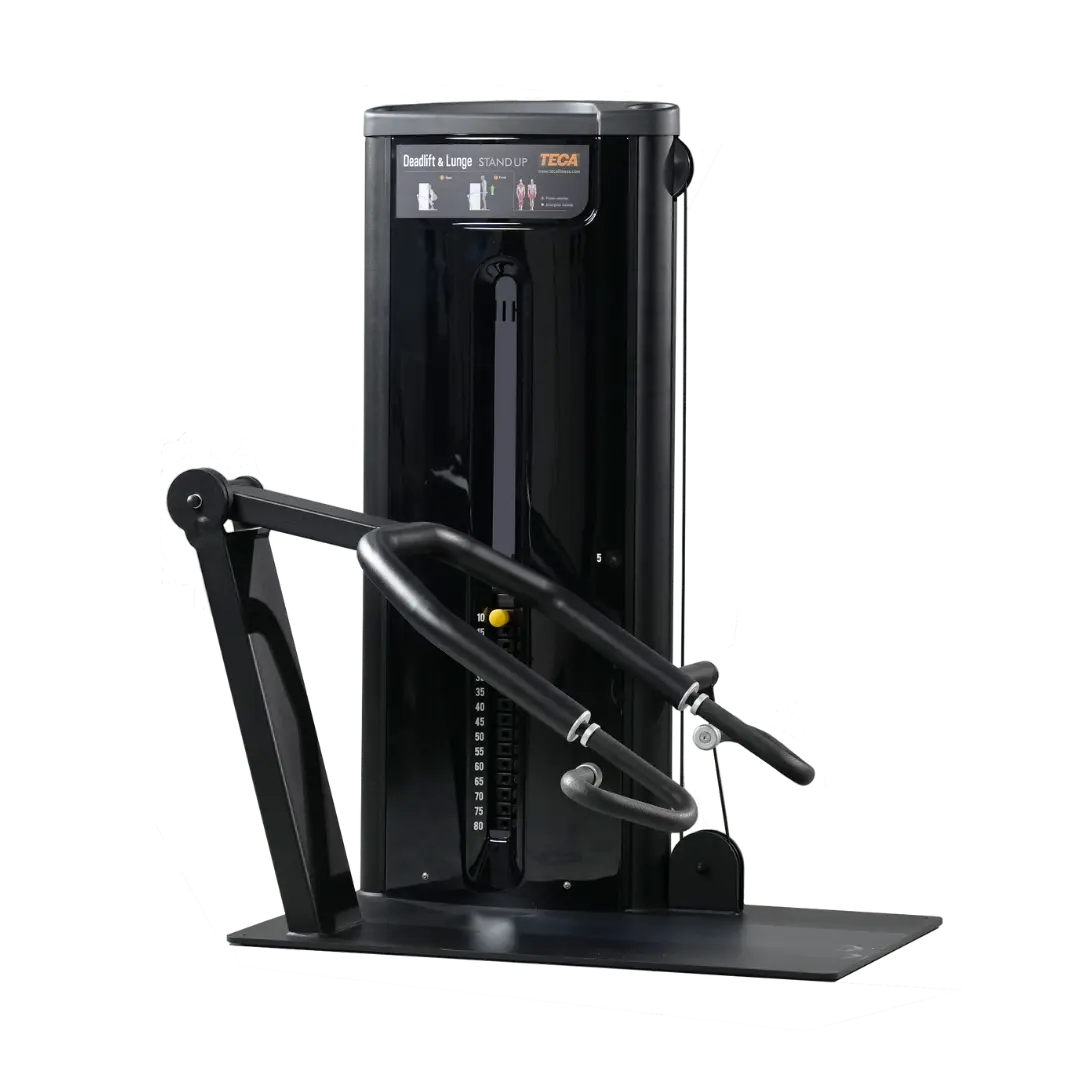
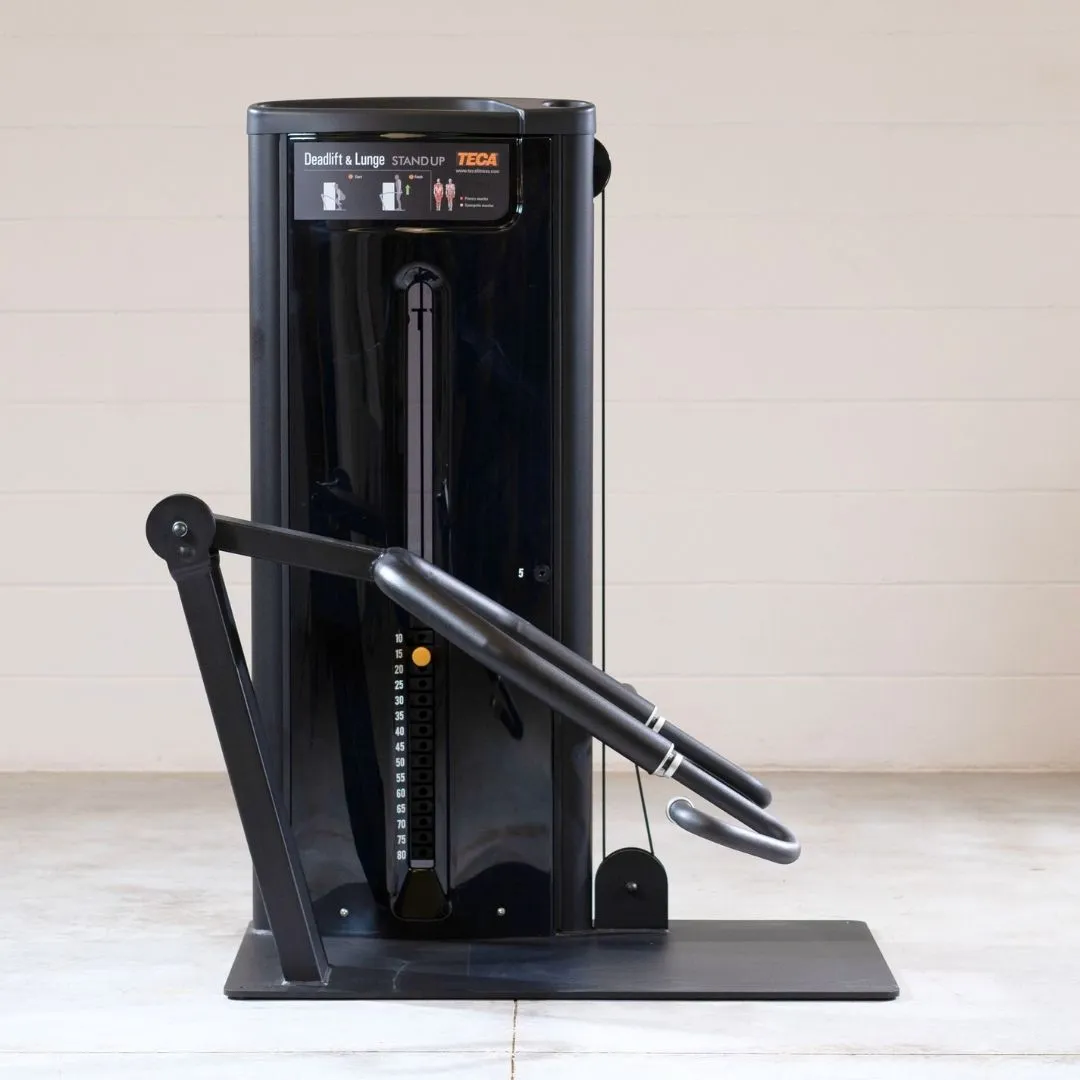
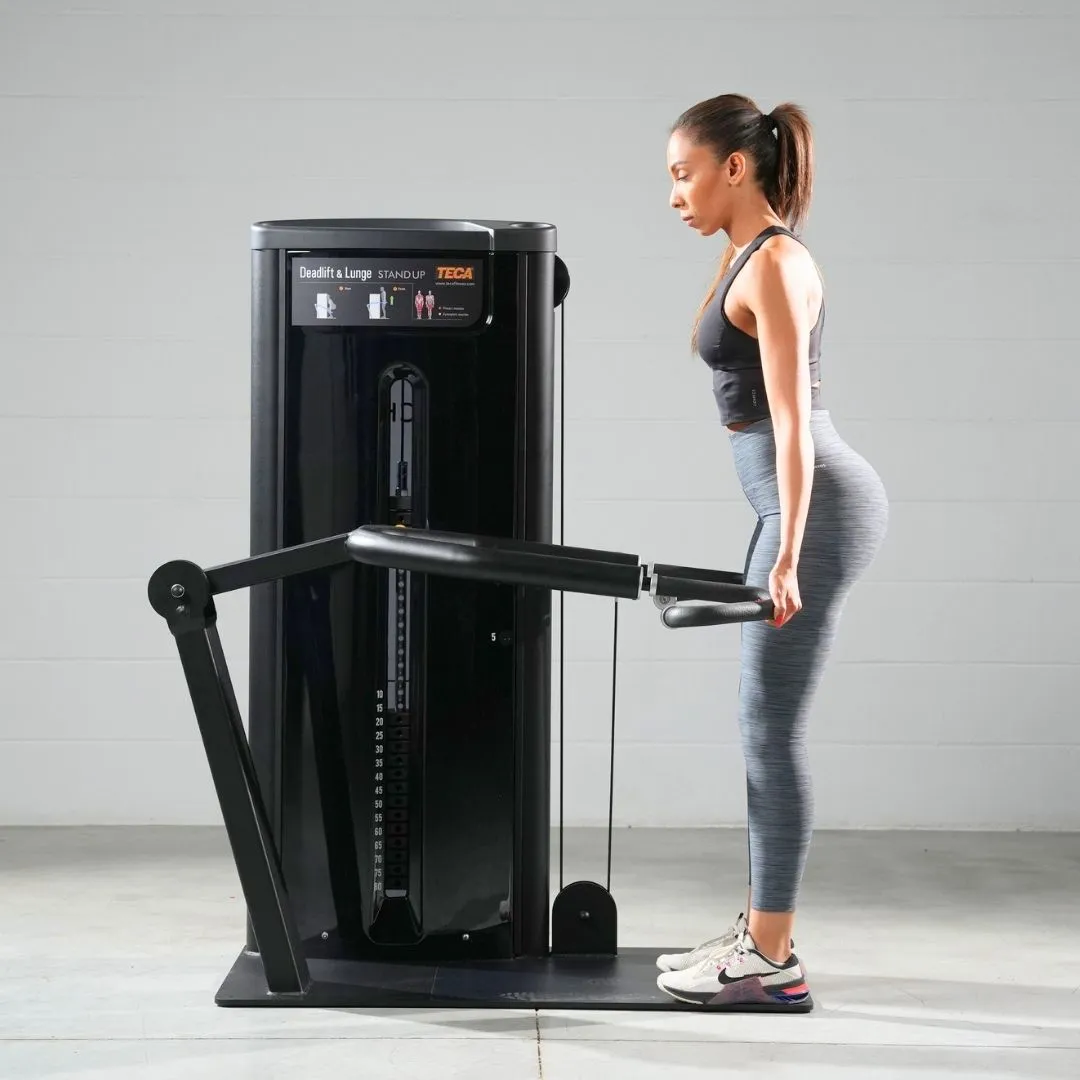
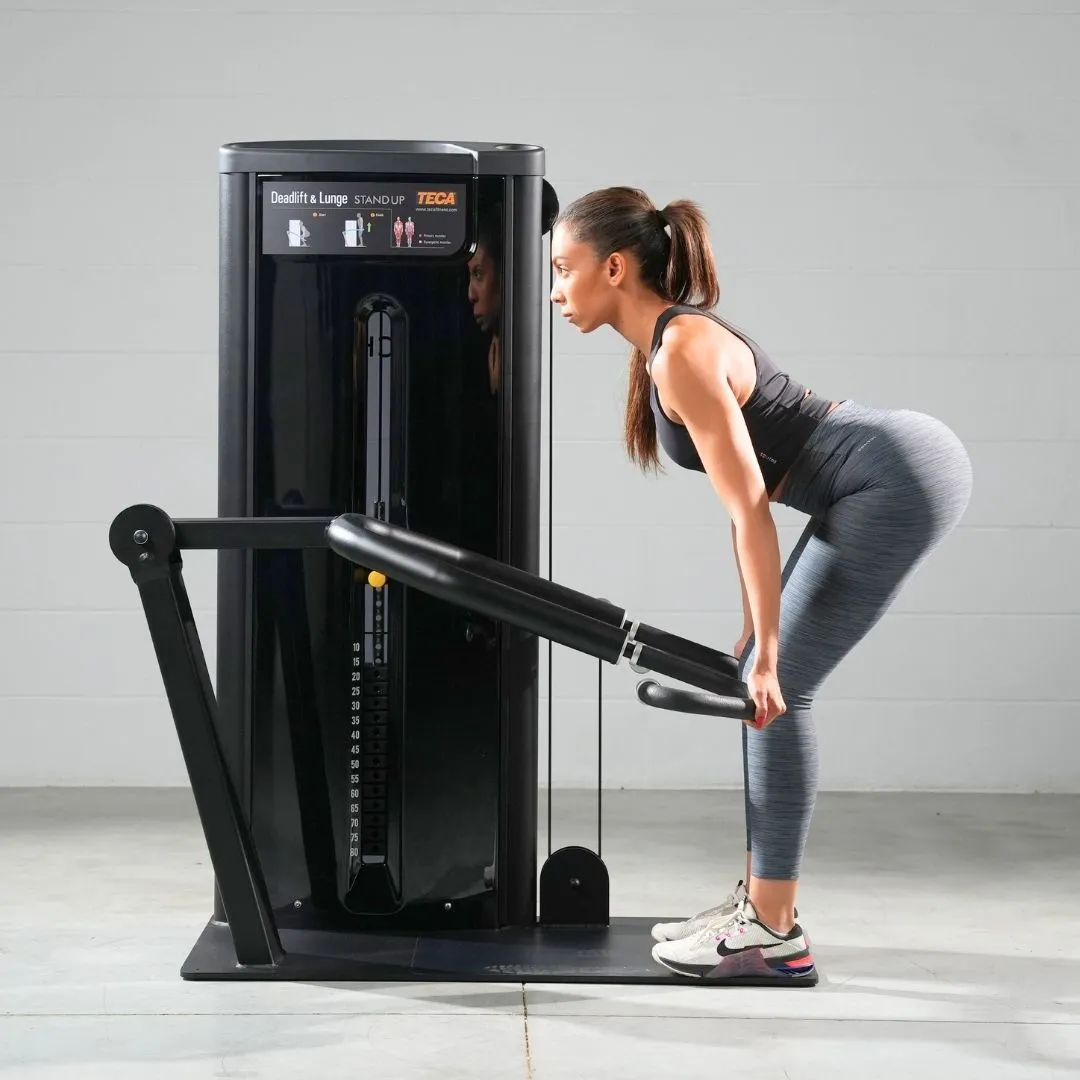
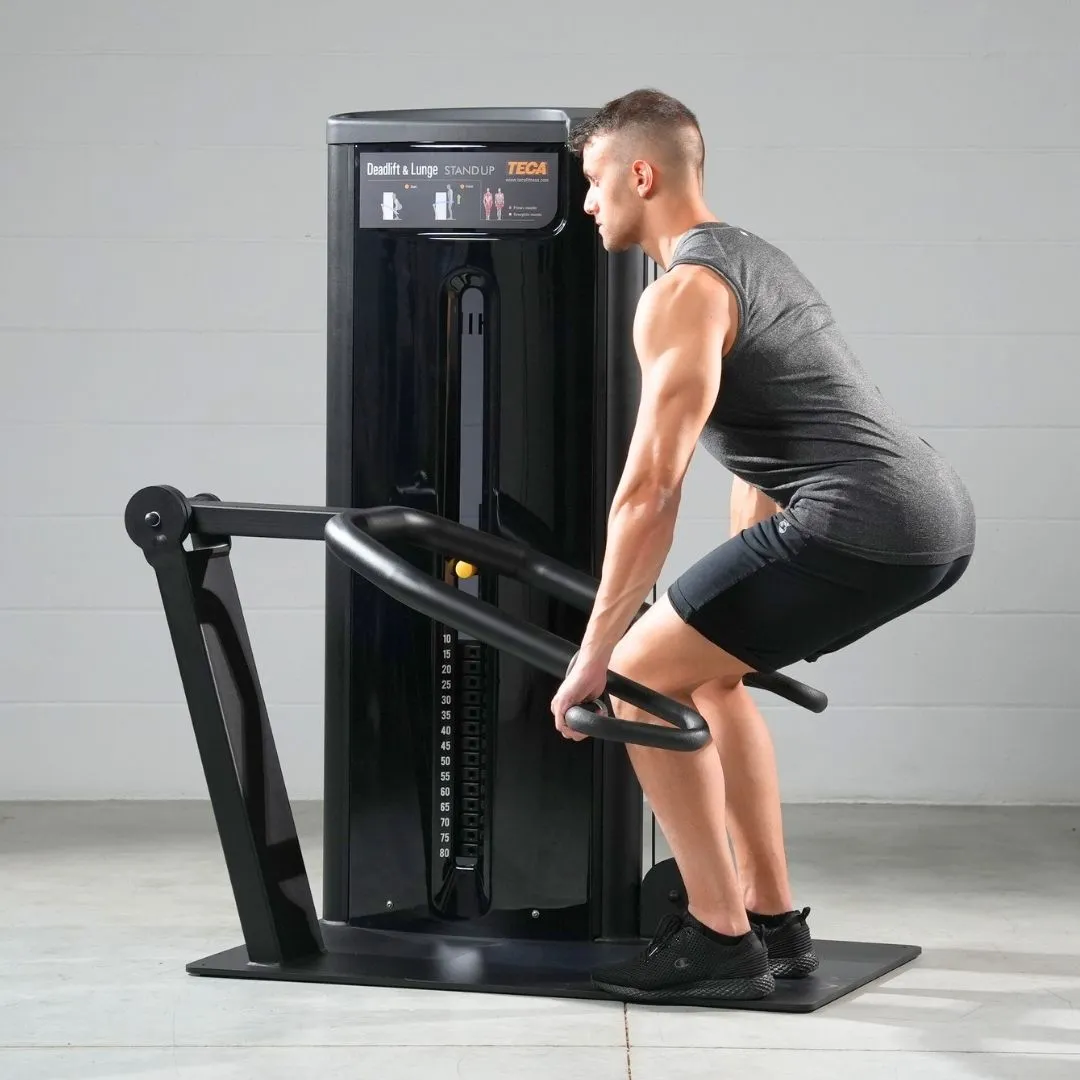
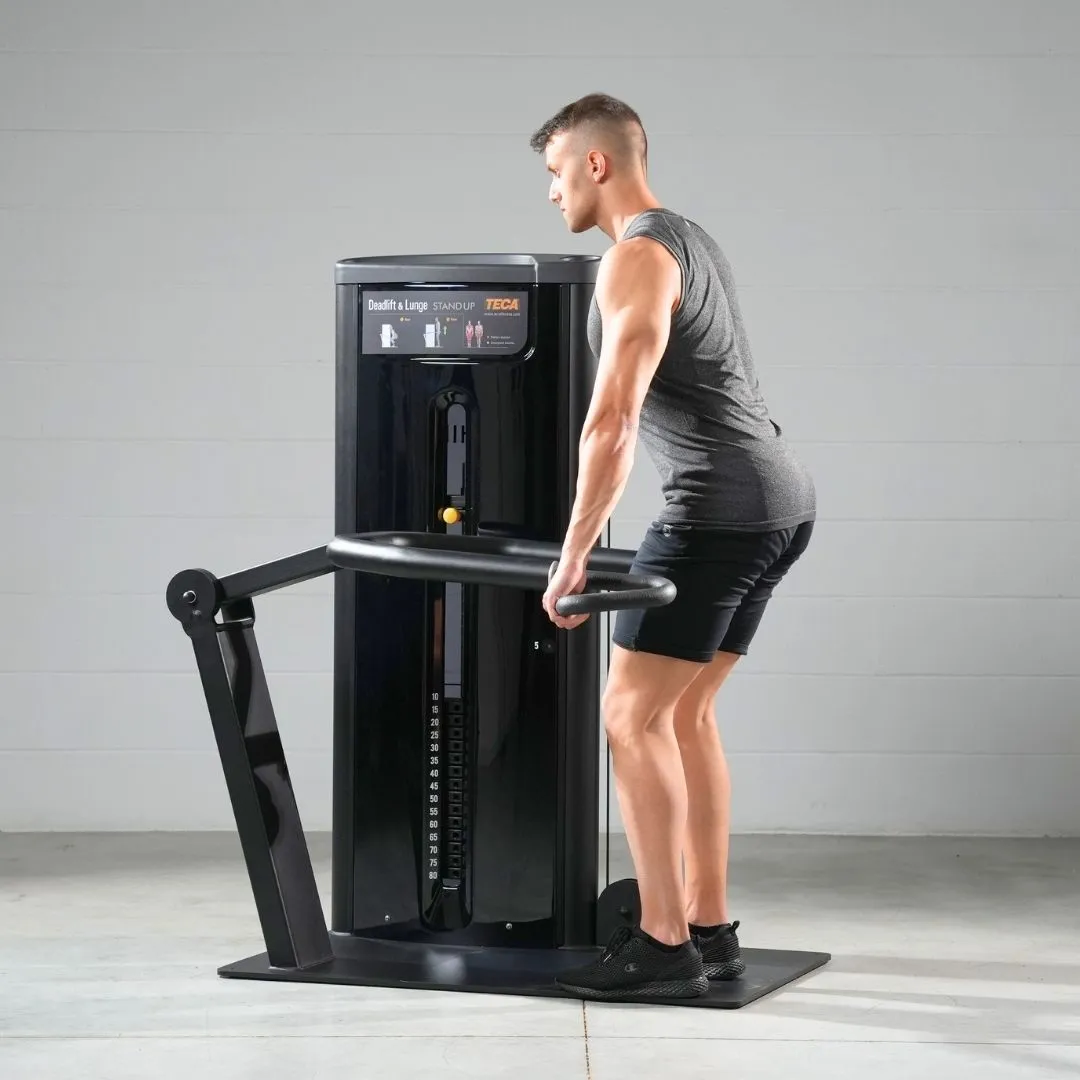
The Deadlift&Hinge StandUp® brings one of the most fundamental training movements— the deadlift — into the club without the technical, operational, and safety barriers that limit the use of free weights. Barbells and trap bars work well only for advanced users, require constant supervision, take up significant space, and frequently lead to technical errors: hyperextended backs, sloppy trajectories, loss of tension, grip failures. The result is a powerful exercise performed only by a small minority.
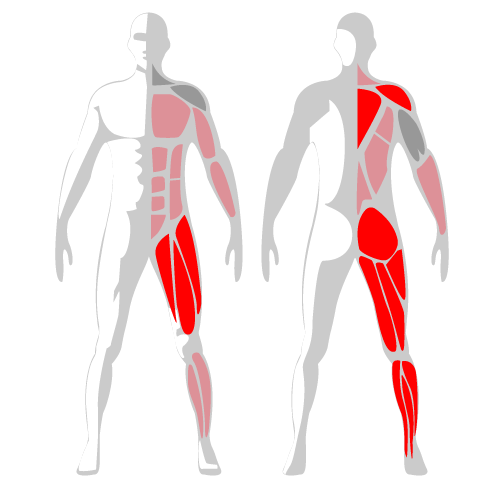
The Deadlift&Hinge StandUp® overturns this model entirely. The upright position naturally stabilizes the spine, removes axial loading, maximizes glute engagement, and allows anyone — women, seniors, beginners, deconditioned users — to perform a deadlift safely and confidently. StandUp® biomechanics enforce a clean pattern: hip-dominant movement, neutral spine, integrated scapulae, aligned knees. Users immediately feel clear muscle activation without intimidation.
For the club, this translates into something very simple: an exercise that used to be elitist becomes democratic. A machine that everyone can use increases rotation, generates more daily traffic, and produces real value per square meter. A trap bar is a cost; a Deadlift&Hinge StandUp® is an asset that works all day long, with no operational risks and no need for dedicated instructors.
Peak hours are always the most critical: crowding, constant requests for help, technical errors on complex movements that drain staff resources. The traditional deadlift is one of the primary causes of this overload: incorrect postures, lumbar pain, poor setup, lack of bracing, off-center bar path. Every mistake requires an instructor’s intervention.
The Deadlift&Hinge StandUp® removes the problem at its root. The machine “educates” the user automatically into a biomechanically correct movement, eliminating 70–80% of typical floor corrections. Members immediately understand how to push, how to hinge, and how to stabilize their spine — without needing to grasp technical concepts.
During peak hours, this has a massive impact: fewer staff requests, less congestion in free-weight areas, greater perceived safety, and more autonomous users. Instructors can focus on PT sessions, reassessments, upsells, and high-margin services instead of repeating the same posture corrections all day. A machine that “works on its own” becomes an accelerator of operational efficiency and a multiplier of profitability.
Limited space is one of the most common challenges: a rack takes up a large footprint, requires a safety zone, creates bottlenecks, and primarily attracts advanced lifters. A deadlift platform is even more demanding: high footprint, vibration, noise, continual maintenance, supervision needs, and often much lower real usage than expected.
The Deadlift&Hinge StandUp® solves all of this instantly. Its vertical structure dramatically reduces floor footprint, requires no safety zone, produces no noise, and does not obstruct traffic flow. It integrates perfectly into compact environments while still delivering a high-value, high-intensity movement. The user performs one of the most effective lifts in the world while occupying only a fraction of the space required for free-weight setups. Commercially, this translates to higher productivity per square meter, more users training simultaneously, smoother flows, and more completed sessions during peak hours. Small gyms, boutiques, and hotels gain a high-value exercise with minimal footprint and maximum accessibility, turning limited space into a high-yield asset.
The perception of a modern club is not built on the number of machines but on the quality of experience. The Deadlift&Hinge StandUp® is an iconic piece: visually striking, technically superior, immediately recognizable. In a market where most clubs look alike, introducing a line that exists nowhere else creates a direct competitive advantage in pricing power.
Users feel the difference at first use: a complex exercise becomes simple, safe, and gratifying. This premium sensation translates into higher willingness to pay for advanced memberships, annual top-tier plans, upgrades to full-access packages, and specialized programs. From a commercial standpoint, a StandUp® machine is not just equipment — it is a sales argument.
For owners, this means increased average membership price, higher conversion rates during tours, and stronger retention in the first 60–90 days — the most critical window for churn. A StandUp® zone reinforces the club’s identity and removes direct comparison with competitors offering standard equipment.
Athletes have precise needs: power, deceleration, unilateral work, motor transfer, and force–velocity cycles performed safely. The traditional deadlift is effective, but it requires advanced technique, constant supervision, and a controlled environment. The Deadlift&Hinge StandUp® makes these patterns accessible even in non-specialist environments, with drastically lower technical risk.
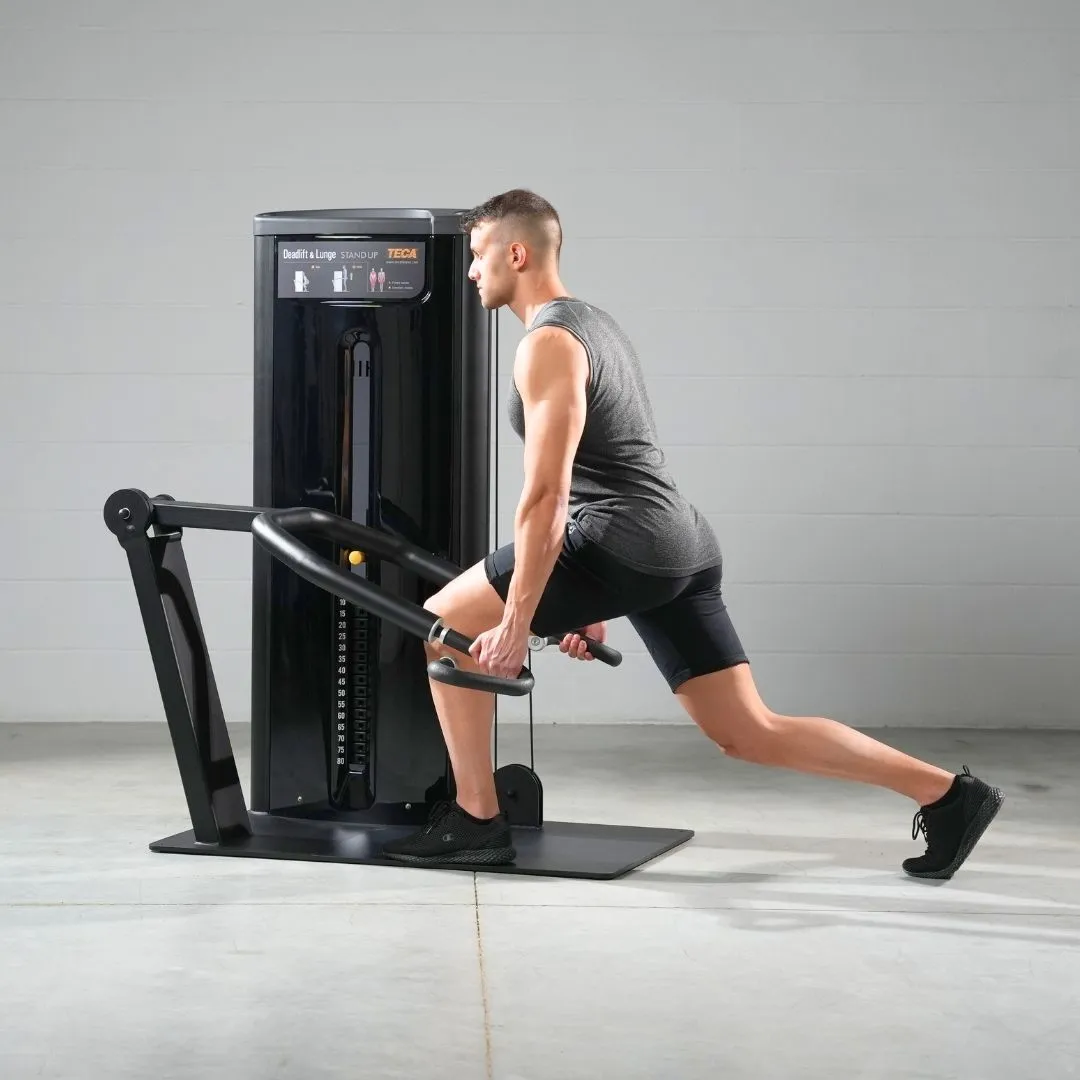
StandUp® biomechanics allow hinge work, hip extension, dynamic lunges, step-backs, anti-rotation drills, strong isometrics, and multidirectional patterns without compromising form. Athletes find a movement that is fluid, natural, and transferable to sport; clubs gain a versatile tool that supports performance-oriented programs without the complexity of an athletic free-weight area.
For PTs and athletic trainers, the machine enables premium sport-specific sessions (tennis, football, basketball, padel, running), making it easier to sell high-margin specialized protocols. For a club that attracts athletes, the Deadlift&Hinge StandUp® becomes a reference point: a device that allows advanced work even for those who do not want — or cannot — use free weights safely.