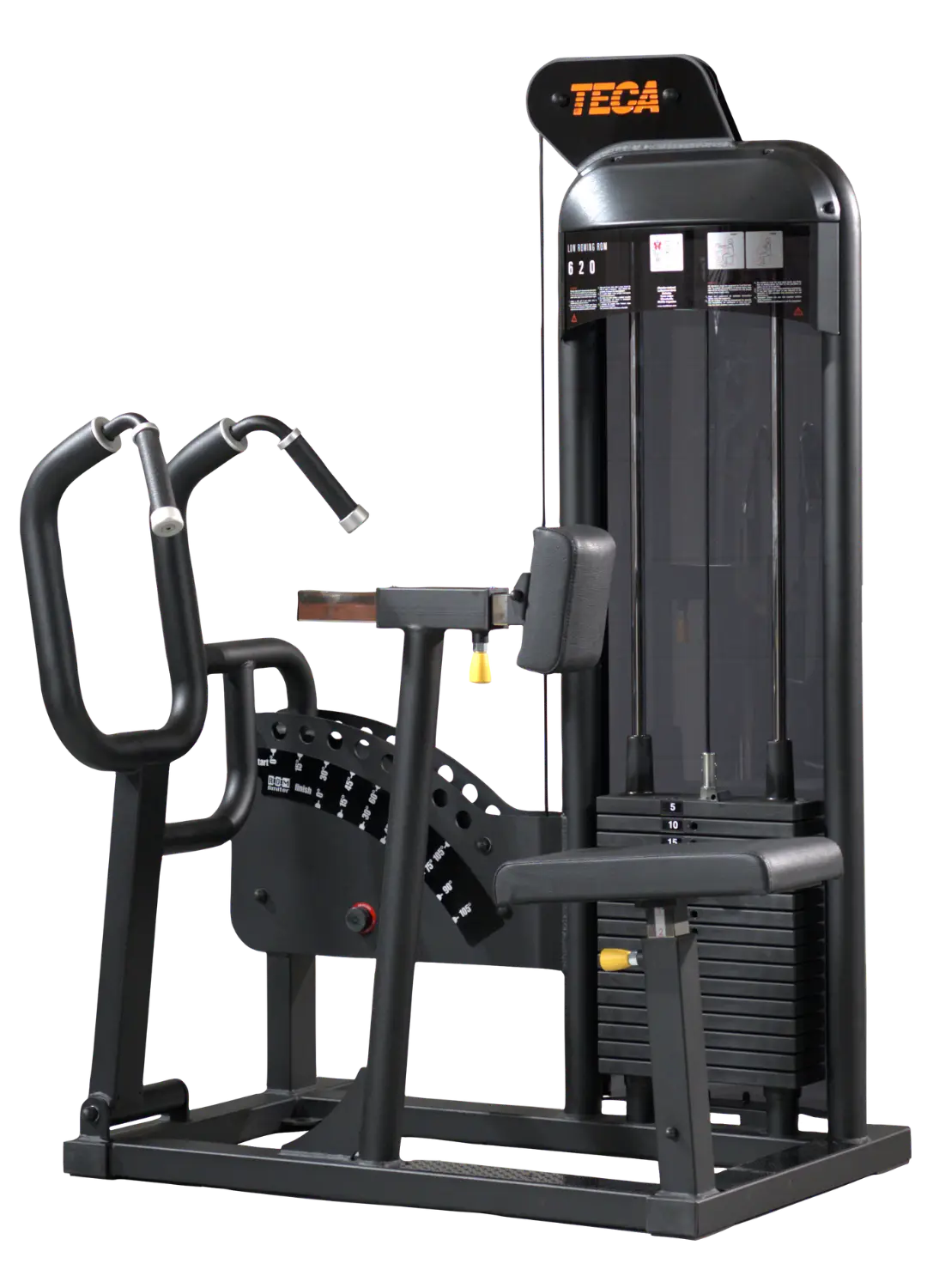
The Low Rowing ROM offers a major competitive advantage because it transforms an exercise typically considered “for advanced users only” into a machine that can be used safely and effectively by the entire gym population. Traditional low rows do not control posture, allow lumbar compensations, and often end up being used only by stronger male members, while everyone else avoids them.
The Low Rowing reverses this dynamic: the ROM Limiter prevents dangerous overextension, the chest support stabilizes posture, and the low ergonomic trajectory makes the movement feel natural even for users with limited scapular mobility.
For the club, this translates into a higher usage rate, greater member satisfaction, fewer requests for instructor assistance, and a more premium perception of the back-training area. A machine that works well for 90% of members is always more profitable than one that only works for 20%. The Low Rowing offers exactly this: an inclusive, modern and technically superior solution that drives more traffic and more long-term value on the gym floor.
The profitability of a machine is determined by three simple factors: how many people use it, how often they use it, and how much commercial value it generates. Traditional low rows underperform on all three fronts: they are uncomfortable, overload the lower back, require constant instruction, and are avoided by women, beginners, seniors and postural users.
The Low Rowing, on the other hand, has a higher usage rate because the feeling of safety is immediate: the user sits down, places the chest against the pad, feels stable, pulls—and immediately perceives clean, comfortable muscular work. This removes the “fear of back pain” that stops many members and increases the number of people who regularly integrate rowing into their training.
For the club, more usage means higher perceived value, fewer alternative machines required, and more opportunities for dedicated coaching (posture, scapular control, back shaping). A machine used daily by all types of users is one that pays for itself quickly and continues generating economic value year after year.
In boutique gyms, hotels and corporate fitness facilities, constant supervision is not always possible and safety needs to be guaranteed at all times. Traditional low rows are risky: one excessive pull or incorrect posture can cause lumbar discomfort.
The Low Rowing eliminates this risk at the source: the ROM Limiter prevents excessive range, the chest support stabilizes the torso, and the movement becomes automatic and self-protected.
For a premium environment, this provides two immediate advantages:
1. Reduced risk even without constant supervision — users can train autonomously and feel safe.
2. Higher luxury perception — the machine communicates professionalism, technical care and attention to health, which in these contexts is more valuable than any design feature.
An intuitive machine reduces operating costs, increases user satisfaction and enhances the facility’s reputation. The SP620 is engineered precisely for environments where quality and safety must coexist in limited space.
With the Low Rowing, personal trainers gain a tool that allows them to sell truly premium programs.
Most traditional row machines limit training to a simple pulling action: no ROM control, no lumbar protection, no ability to customize the movement.
The Low Rowing changes everything: the ROM Limiter enables technical progressions, the chest support guides posture, and the low trajectory targets rhomboids, mid-traps, lats and scapular retractors with exceptional precision.
This allows PTs to build programs for:
– Posture: rounded shoulders, kyphosis, weak posterior chain
– Aesthetics: V-shape, back sculpting, upper-back density
– Functionality: scapulothoracic stability, shoulder protection
– Reconditioning: fragile users, stiffness, post-injury work
A machine that supports so many high-value technical variants automatically becomes a commercial asset: it generates more PT sessions, more specialized programs and greater member retention.
For a club, this becomes a direct lever for monetization and differentiation.
On traditional machines, low rows are often perceived as “uncomfortable”: unstable torso, unnatural pulling path, and lumbar tension. As a result, many users avoid them.
The Low Rowing solves this through a design that combines guided posture, ergonomic trajectory and mechanical fluidity.
The chest support removes instability and immediately makes the user feel secure; the low, natural pulling path works well even for those with limited scapular mobility; and the fluid motion provides immediate muscular engagement without discomfort.
Comfort → more usage.
Control → fewer risks.
Premium sensation → stronger retention.
For a club, this translates into a machine that never sits empty, because average users perceive it as accessible, satisfying, and useful. In other words: ergonomic design isn’t just aesthetics — it’s a practical tool to increase traffic, satisfaction and strength-area efficiency.